
(Return to Family List)
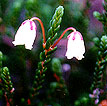
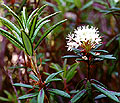
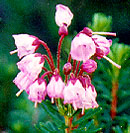
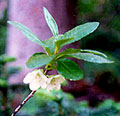
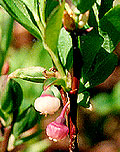
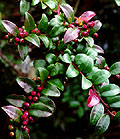
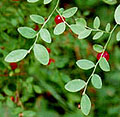
The Ericaceae is an abundant and diverse family in western Washington. One of the reasons they are so abundant here is that members of this family don't have the enzyme required to convert soil nitrate back into ammonia. This means that they have to take up nitrogen as ammonia directly, and so require acidic soils in which the bacteria that convert ammonia to nitrate are relatively scarce. Many Ericaceae are valuable ornamentally (e.g., Rhododendron, Actostaphylos, Gaultheria, Arbutus), and the blueberries and cranberries (Vaccinium) are important as foods.The typical flower of the Ericaceae is small, pendent, and urn-shaped. The sepals and petals are generally fused with 4 or 5 lobes each. The anthers are often inverted, and sometimes have awnlike projections from the back or tip. Generally, the anthers open by terminal pores. The pistil consists of 4-5 fused carpels, with a single style and stigma, ovary superior or inferior. A Gaultheria flower is fairly typical. Rhododendron, as well as most of the herbaceous species, has reverted to distinct petals, but other characteristics of the family remain.