  |
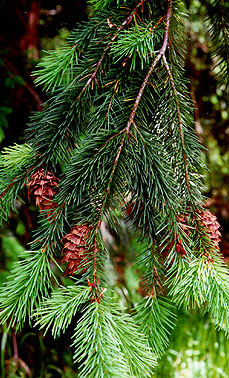
DOUGLAS FIR Pinaceae Douglas fir is the only species in its genus in western Washington and usually the most abundant tree in second-growth coniferous forest. It is a favorite of the lumber industry because of its rapid growth to a height of 70-90 m. The leader is stiffly erect and the branches droop but often curve up at the tips ("J shaped"). The bark is very thick, rough and dark brown in mature trees. The needles of Douglas fir are flat, yellowish-green, 2-3 cm long with two white bands of stomata on the lower surface. When grown in full sun, the needles surround the branches, but shaded branches often show needles in two ranks (similar to grand fir). However, the buds of Douglas fir are reddish-brown and sharply pointed, very different from the small rounded buds of grand fir. The female cones are pendent, oval, 5-10 cm long, and reddish-brown at maturity. The scales are papery and the exserted bracts are 3-forked, unlike any other coniferous cone. Douglas fir grows over a wide range of habitats from extremely dry low-elevation sites to moist mid-mountain slopes. In many areas, the dominance of Douglas fir is maintained because of frequent fires; without fires, Douglas fir would be excluded since its seedlings cannot establish in shade. However, because established trees can live more than 1000 years, such exclusion can take a very long time. Many ancient old-growth forests contain giant Douglas fir trees that mark sites of fires many centuries ago. Pollen records indicate that Douglas fir did not appear in western Washington until about 7000 years ago. |