 |
|
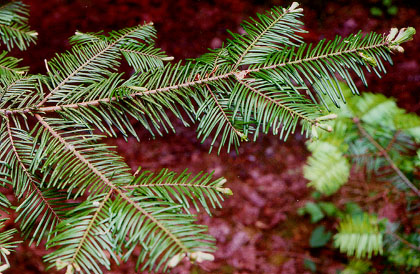
GRAND FIR Pinaceae Grand fir is a tall (to 80 m), straight, stately tree. The bark is greyish-brown and smooth with resin blisters when young, becoming ridged and scaly with age. The 2-4 cm long needles are flat, blunt, dark green above with two white lines of stomata below and arranged in two horizontal ranks with the branch clearly visible between them from above and below. The blunt needles make the branches non-prickly when grasped ("friendly fir" as opposed to "spiny spruce"). As in all true firs, needles leave a flat circular leaf scar rather than a raised peg. The branches form distinct horizontal sprays. The female cones are yellowish-green to green, cylindrical, upright, and 5-10 cm long. They are borne high in the tree where they slowly shatter through the autumn. Grand fir is found in dry to moist coniferous forests, but most abundantly in regions with less than 150 cm of rainfall annually. It commonly occurs in the understory of, and occasionally is co-dominant with, Douglas fir. Grand fir also occurs on fairly dry slopes of the west Cascades from low to middle elevations. Like most other true firs, grand fir is thin-barked and very sensitive to fire. Fire suppression has allowed grand fir to increase over much of the drier parts of western Washington in the last 50 years. |