  |
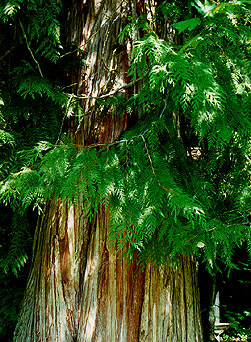
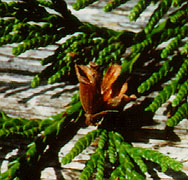
WESTERN RED CEDAR Cuprussaceae Western red cedar is a large tree, up to 60 m tall, with a drooping leader. The branches tend to droop slightly and then turn up at the end ("J-shaped"). The bark is grey to reddish-brown and peels in long vertical strips. The yellowish-green scale-like leaves are paired in 4 rows, with the leaves of one pair folded and the other not; both pairs are closely appressed to the stem in overlapping rows that look like a flattened braid. When brushed "against the grain," the branchlets are not prickly. The foliage and inner bark of western red cedar both have a pleasant "cedar" smell. The female cones are oblong and greenish when young, and become brown, woody and turned upward when mature. Red cedar is found mostly on moist to wet soil, usually in shaded forests, but also on drier sites, from low to middle elevations. Western red cedar is more shade tolerant than yellow cedar and generally outcompetes yellow cedar where their ranges overlap. Western red cedar is apparently very sensitive to breakage of its leader and snow accumulation apparently limits its northern distribution. Western red cedar has been called the "cornerstone of the northwest coast Indian culture." The wood is easily split, rot-resistant, and was used to make a host of important cultural items including canoes, lodges, totems, baskets, and clothing as well as a huge variety of tools and implements. |