|
by Nick Haslam
In Galacia
|

It has been a year since the oil tanker Prestige began to leak oil into the Atlantic off Spain's North West coast.
On a stormy morning last November, Xose Bermudez awoke with a sense of foreboding.
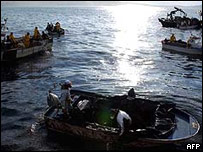
Oil from the Prestige has ruined the livelihoods of local fishermen
|
He lives in the fishing village of Arou, on Galicia's
rugged Atlantic Coast. Usually he wakes to the low rumble of the sea,
but on that day the breakers were strangely muted.
Outside he found his neighbour gazing with horror down
the beach which was covered in a thick black tide of oil, dotted here
and there with dead and dying seabirds.
"We were desperate," remembered Xose, a stocky man in
his early 30s. "We love the sea. Some of us wept for we thought it was
the end."
Now, nearly a year on, Xose and I walk through autumnal
sunshine along a path just outside Arou, a pretty village tucked
beneath steep cliffs, where most of the families make their living from
the sea.
Beneath the surface
Below high water mark, the rocks around us looked clean
but Xose pointed out telltale patches in rock pools where traces of
heavy oil were still leaching to the surface.
"This area here," he said, pointing to the bay "was
thigh deep with thick black sludge. It killed everything, from fish to
sea birds".
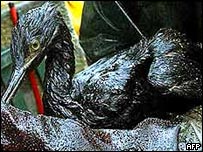
Terrible toll on wildlife
|
The week before, marine biologists had finally given the
sea a clean bill of health, lifting the inshore fishing ban imposed
when the Prestige went down.
Not far from where we stood, fishermen were scrambling from launches onto rocky outcrops.
They were gathering percebe, the goose barnacle - a prized delicacy in Spanish restaurants.
It's hazardous work, the men clad in wetsuits working
quickly to gather shellfish and then scrambling for safety out of the
reach of the big Atlantic swells.
But with barnacles fetching high prices, fishermen can make enough to keep their families with three or four hours work a day.
When the Prestige went down, Xose had joined fishermen
in huge mass demonstrations of protests in the Galician capital
Santiago and in Madrid.
Spain's ruling party, the Partido Popular, Xose told me
cynically, had important elections coming up in the spring of 2003, so
had been anxious to avoid confrontation.
Within three weeks, each fisherman along the Galician
coast was guaranteed a minimum monthly aid cheque of 1,000 euros with
Xose, as the skipper of a small boat, receiving slightly more.
 |
 We're doing something to save our coast

|
The military were mobilised to help and in a spontaneous
movement of solidarity, hundreds of national and international
volunteers descended on the Coast of Death.
Throughout the winter Xose worked with his fellow
fishermen and with the volunteers to manhandle thousands of buckets of
toxic black sludge off the shoreline, sometimes working in long human
chains strung over rocky headlands.
By the end of spring this year, the beaches looked clean
again, but publicity generated by the disaster kept tourists away, and
with the sea still too polluted to fish the local economy was hit hard.
Xose's mother, who is a widow, supplemented her pension
by renting rooms in the summer but this year she had less than half the
usual number of guests.
Community spirit
In a cove around the point, we found Xose's sister, Rosa
Bermudez, and two other village women busy at work scraping boulders
clean of oil forced deep into clefts by the winter storms.
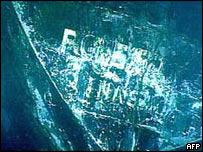
Prestige looms on the seabed
|
A part of the government sponsored cleaning teams,
their white protective overalls and face masks made an odd contrast
with our shorts and T-shirts in the warm sunshine.
It looked a thankless task, but Rosa was upbeat.
"We're doing something to save our coast," she said. "At least we're getting paid instead of sitting at home."
But the month before 130 workers had been laid off
leaving only 70 to continue the Herculean task of cleaning a small
section of coast.
"There are rumours they will fire us all at Christmas,"
she said filling another bag, "and as you can see there's years of work
left here."
When the fishing ban was lifted at the end of this
summer, the monthly aid cheques to fishermen stopped and at the tiny
port of Santa Marina close by, launches were once again landing
catches.
|
We think the government has already forgotten us
|
We joined Xose's uncle, Manuel Bermudez, who was cleaning his catch of percebe on the slipway.
He showed me the bizarre looking barnacles each with a stalk the size of a little finger.
"There are still plenty of them out there," he said.
"But some sections of the rock are bare and look as if they've been
burnt."
Manuel told us his major worry was the remaining 14,000
metric tons of oil still in the hull of the Prestige which now lay in
deep water 240 kilometres off the coast.
"We live in fear of what this winter's storms might bring," he said.
Xose nodded angrily. "We think the government has already forgotten us," he said.
"They promised emergency measures but they haven't even
got a tug on permanent stand by here. If that oil washes up again,
it'll mean the end of fishing and all the communities along this
coast."
From Our Own Correspondent was broadcast on Saturday, 15 November, 2003, at 1130 GMT on BBC Radio 4. Please check the programme schedules for World Service transmission times.
|










 E-mail this to a friend
 Printable version

 Radio 4 edition

