 |
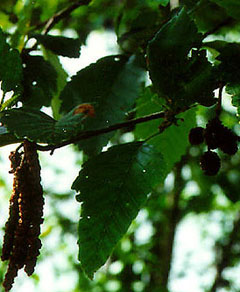
RED ALDER Betulaceae Red alder is a small deciduous tree up to 25 m tall, with thin, smooth, gray bark almost always supporting white patches of lichens. The wood and inner bark turn rusty-red when cut. The leaves are alternate, broadly elliptic but acute at the tip, and 5-15 cm long. The upper surface is dull green and smooth; the lower surface is rust-colored and hairy. The leaf margins are wavy with coarse, blunt teeth. The male flowers are in elongated, pendent catkins (5-12 cm) whereas the female flowers are in short, stout and eventually woody "cones." The seeds mature in late fall and clusters of the empty brown cones remain on the tree throughout the winter. Red alder generally occupies nitrogen-poor soils, often water-logged, because its roots are associated with a nitrogen-fixing actinomycete, Frankia. Because of its ability to add nitrogen to the soil, alder forests generally have a rich understory of grasses, sedges and ferns. |